The AI-Native
Marketing
Organization

Marketing has only ever scaled by adding people. AI is the first way to add capability without adding headcount — but buying AI does not make an organization AI-native. What does is a factory the organization owns: what it knows, how its work gets done, what good looks like, and the agents that run on all three. This is how a marketing team builds one, and why the people already inside it are the ones who will.

Sectional drawing of a factory engine house, with overhead crane, hanging hooks, and chimney.
Part 01
01

The problem

The old scaling law

Hiring and retaining an agency look like different models. Economically they are the same. Both buy capability by the person. Both require every new person to learn the business. Both add handoffs and coordination as they grow, and both lose what people know when those people leave.

Marketers have been trying to escape that equation for decades. In-housing was one attempt, and the instinct was right: own the capability, the data, the relationships and the institutional knowledge instead of renting them. But in-housing still meant hiring. It brought capability inside by bringing headcount inside, so the scaling law remained. More capability still required more people.

What AI changes

For the first time, there is a way to bring capability in-house without bringing equivalent headcount in-house. That is the real promise of AI for marketing — not writing an email faster, not generating fifty headlines, not giving everyone a chatbot. A marketing organization can now add capability without opening a job req. Hire a person and you get one person's output. Teach an agent how a campaign review works and every marketer has it on Monday — and the next correction improves it for all of them at once.

But buying AI does not make an organization AI-native. Giving everyone Claude seats does not make it AI-native. Neither does a Slack channel full of prompts, or buying an “SEO agent,” a “paid media agent” and a “content agent” from three different vendors. Those are tools.

An AI-native marketing organization is something different. It can build, teach, evaluate and manage an AI workforce of its own.

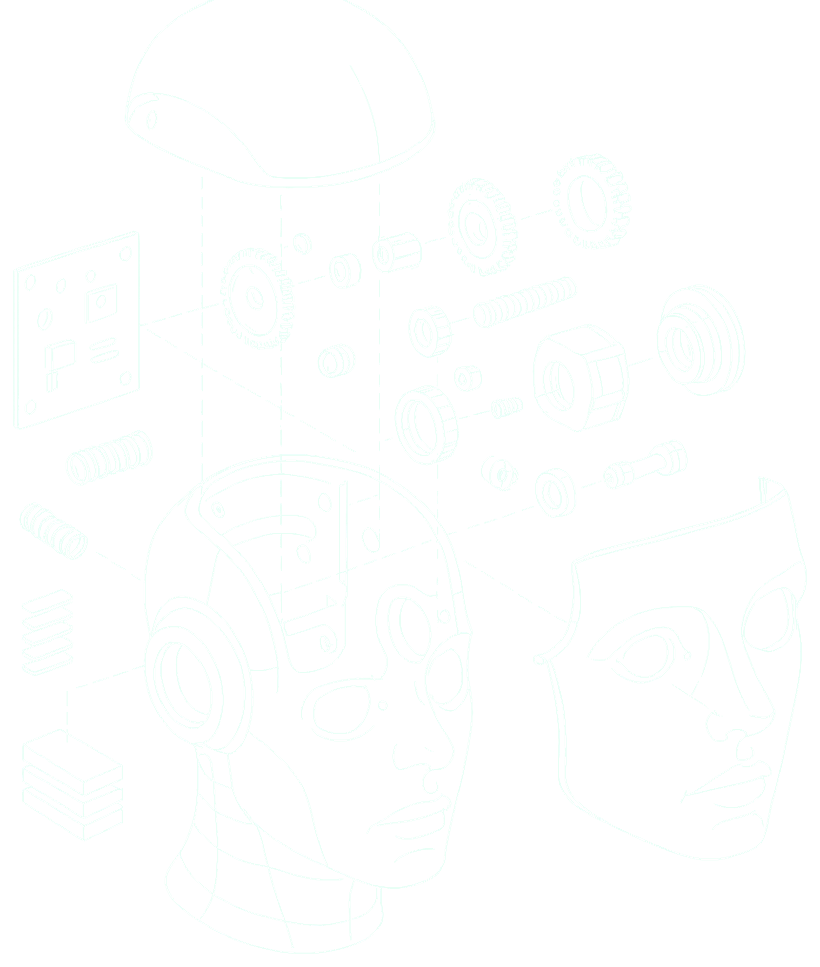
PL.01the head, taken apart

It treats AI like any other member of the team. Nobody hands a new hire a login and judges them on their first answer. Nobody keeps someone on whose work they never review. Nobody expects a good hire to stay useful without ever being told what changed. Every one of those instincts is already in the building, and almost none of them currently get applied to AI.

An AI-native marketing organization is not one that has bought AI tools. It is one that can build, teach, evaluate and manage an AI workforce of its own, adding capability without adding headcount.

Part 02
02

The factory

How a factory works

PL.02flywheel in section

AI-native means humans and machines working well together. That is not a new problem, and marketing does not have to solve it from scratch. There is a century of prior art, and the clearest example is the factory.

A factory is not a building full of machines. It is people and machines on one floor, arranged so that each does what it is good at. Machines take the work that is repetitive and precise, and they never tire of it. People take the work that needs judgment — what to make, what counts as a defect, when to stop the line. A well-run factory has nobody doing a machine's job by hand, and no machine deciding what is worth building. Split that way, the floor turns out more than the people and the machines could turn out separately. That is the entire reason the arrangement exists.

The marketing version is the same split. Humans bring taste, judgment, creativity, relationships and an understanding of the business. Agents bring speed, scale, memory, synthesis and the ability to work continuously.

The four inputs

That factory needs four things, and they are the part nobody can supply from outside. Each of them already has a name on a factory floor.

The four inputs
01The master drawing
Brain
What is true hereWho the customers are. Which numbers the team trusts. How the funnel is defined. What was tried last quarter. Everything a new hire would need months to learn.
02The work instructions at one station
Skills
How this job gets done hereHow a campaign gets analyzed, a brief built, a funnel problem diagnosed, creative reviewed. Which steps to follow, which inputs matter, and what to do when one is missing.
03The gauge on the bench
Evals
What good looks like hereWhat an agent has to get right, and what it should refuse to answer. When something fails, whether the cause was missing knowledge, bad retrieval, bad reasoning or a bad process.
04The trial run
Tests
Whether a change made it betterShould this skill carry the competitor context? Does the agent do better with the full brief or a summary? Evals say whether the work is good; tests say whether a change improved it.

The line

A machine on a factory floor does not assist a worker while the worker does the job. It does the job. The work moves down the line, and a person inspects what comes off it — checking quality, catching defects and deciding what needs to change.

That is the higher-leverage arrangement AI makes possible in marketing too. A marketer should not spend the day working step by step beside an agent. They should be able to hand work to many agents, let them execute it, and spend their own time where human judgment matters: reviewing what comes back, deciding what is good, and directing what happens next.

The marketer moves from producing every piece of work to directing a system that produces work.

And inspection does more than catch defects. When a human corrects the output, that correction can go back into the brain, the skill or the standard that produced it. The next run gets better, and the correction stays corrected.

A correction trapped in a chat window fixes one deliverable. A correction returned to the factory improves every future execution of the job.

Part 03
03

Running the factory

The hard part

Almost everything required to build this factory is getting easier. Software that once required a team of engineers can now be built by one capable person in an afternoon. Agents are getting easier to create, models are getting smarter, and memory, handoffs, permissions, context and evaluation will become native features of the tools themselves. A lot of the technical work being done today will stop mattering, and that is good, because the hard part was never going to be building the software. The technical work becomes obsolete. The organizational learning does not.

The hard part is changing how people work.

PL.03the boardroom, in plan

Today's marketing organizations were built around humans doing the work. The marketer writes the brief, pulls the report, analyzes the campaign, runs the research, builds the deck, reviews the creative, manages the agency. Job descriptions, workflows, incentives and management structures all assume that model.

An AI-native organization asks those same marketers to work differently. They still own the outcome, but increasingly they do not perform every step required to produce it. They teach agents how the business works, turn repeated work into skills, define what good looks like, review output and explain precisely what is wrong, decide what requires human judgment and what can be delegated, and grant more autonomy as agents prove themselves.

The marketer moves from doing the work to designing, directing and improving how the work gets done. That is not a software rollout. It is a people transformation.

The hard part of going AI-native is the organization, not the technology.

Three new jobs

Someone has to lead this, and the obvious response is to go hire one. There is just one problem: they barely exist. The title is new, the people who are good at the work mostly taught themselves recently, and every company searching for one is competing for the same tiny pool.

Even if there were thousands of them, hiring would be the wrong strategy. You cannot replace a marketing organization with a new class of technical employee, and you should not want to, because the people already inside hold the scarce thing. They understand the customer and know the brand. They know which numbers to trust and which ones everyone quietly ignores. They remember what was tried, what failed and why. They know what great work looks like here.

So going AI-native does not mean replacing marketers. It means expanding what marketers are responsible for. As agents take on more of the execution, three new jobs appear inside the organization that already exists.

REQ · 01

Agent Hiring Manager

Owns

The roster. Which agents exist, what each one is responsible for, and which jobs stay with people.

Does

Writes the job before the agent — the context, skills and standards it needs to hold the role.

Grants

Autonomy job by job. Answer, then recommend, then act, and never before it is earned.

REQ · 02

Context Curator

Owns

What the organization knows. The brain, and whether it is still true this quarter.

Does

Gets knowledge out of heads, drives, meetings and chat histories, and into a form agents can use.

Ends

The arrangement where the marketer is the brain and reloads it by hand every morning.

REQ · 03

Factory Manager

Owns

The line. Throughput, quality, and where a human still stands between the work and the customer.

Does

Reviews and annotates. Diagnoses a failure once, then makes sure it cannot happen a second time.

Improves

The system that produces every deliverable, rather than the deliverable in front of them.

These are not three people to hire. They are three responsibilities marketers learn to take on, and none of them is foreign to marketing. Marketers already onboard new hires. They write briefs and SOPs. They teach junior people how work gets done. They know what good work looks like. They delegate, review and give feedback. What changes is that those same abilities now manage machines as well as people.

You cannot hire your way to an AI-native marketing organization. The role barely exists yet, and the marketers already inside the company hold the scarce thing: they know the customer, they know the brand, and they know which numbers to trust.

The marketing engineer

That is what we mean by a marketing engineer. Not a marketer who happens to code, but a marketer who can turn what they know — context, process and judgment — into a system that people and agents operate together.

Marketing engineer is less a new profession than a new way of practicing marketing.

The transformation

Nobody becomes a marketing engineer overnight, and no organization becomes AI-native all at once. The transformation happens one job at a time.

Take campaign analysis. At first the marketer does the analysis and uses AI along the way: they attach the report, explain the campaign, paste in the historical context and tell the model which numbers to trust. The marketer is the brain.

So get that knowledge out of their head. Give the agent persistent access to the campaign history, the business context, the metric definitions and everything else it needs to understand the job.

Then teach it how the work gets done. The marketer records how they analyze a campaign: where they start, which inputs matter, what they compare, what they investigate when something looks wrong. The work becomes a skill.

Then make judgment explicit. What does an excellent analysis contain? Which conclusions require evidence? Which questions should the agent refuse to answer? What mistakes should never happen twice? Judgment becomes an eval.

PL.04operator console, exploded

Now the agent can take the job. At first it produces an answer for the marketer to review, then a recommendation, then the finished analysis. Eventually, where it has demonstrated enough reliability, it can take the next action itself. Answer. Recommend. Act. Autonomy is earned job by job.

The marketer has not disappeared. They have moved up the line: instead of assembling the analysis, they teach the system how to produce it, inspect what comes back, exercise judgment and improve the process when something is wrong.

Now do it again. The next job might be creative analysis, or competitive research, or building a brief, or preparing the weekly performance review. With every job that changes, the marketer spends less time performing repeatable execution and more time directing, judging and improving a system that can perform it at scale.

Some of the work required to get there is temporary. Recording a meeting because an agent cannot attend it yet. Writing out a skill a future model may infer on its own. Connecting tools that will eventually talk natively. That is fine. The wiring is temporary. What the organization learns about dividing work between people and machines is not.

Transform enough jobs and the marketer changes. Transform enough marketers and the organization changes.

A marketing organization goes AI-native one job at a time: get the company's knowledge out of people's heads, turn repeated work into skills, turn judgment into evals, then grant agents autonomy as they earn it.

The asymmetric team

Creating an AI-native organization does not require every marketer to become equally technical. It should not.

Start with a champion or two — the plain word for the marketing engineer — willing to go deeper. They get the first team-wide context into the brain, build the first skills and agents, establish the first evals, learn where the tools break, and create the conventions the rest of the organization can follow. They go first so that everyone else does not have to work everything out for themselves.

But they cannot make the organization AI-native alone. The rest of the team holds the knowledge, process and judgment the factory needs. The paid media lead knows how campaigns should be analyzed. The product marketer knows the customer. The brand lead knows what good creative looks like. The manager knows which decisions require human judgment.

They do not all need to learn agent architecture. They do need to change how they work: get what they know into the shared brain, teach agents how their work gets done, make their judgment explicit enough that an agent can be evaluated against it, delegate work they used to execute themselves, review what comes back, and correct the system instead of only correcting the deliverable.

The technical burden can be concentrated. The change in how work gets done cannot be.

That is the marketing engineer's role in the transformation. They are the person furthest along the path, accountable for bringing the organization with them. Their job is not to personally build every agent, curate every piece of knowledge or review every output. If it were, the organization would have simply moved the bottleneck into one unusually technical marketer.

Their job is to make the organization more capable. They establish the first patterns, help marketers take on the new responsibilities, look across the factory for what should change next, spread what works, and keep asking whether the division of labor should change as AI improves.

Because this transformation does not end. Every major improvement in AI can redraw the line between people and machines. Work that required a person can move to an agent. An agent that needed supervision can earn autonomy. A workaround can disappear because the model suddenly does the thing natively.

So the marketing engineer has two jobs: get the organization AI-native, and keep it there. They should own that transformation, because they know their business better than anyone outside it ever could. But going first should not mean inventing the discipline from scratch, and staying at the frontier should not require one marketer to independently test everything AI makes possible.

A marketing engineer establishes the first patterns, helps marketers take on the new responsibilities, spreads what works, and keeps asking whether the division of labor between people and agents should change as AI improves.

Part 04
04

That is why we built Bamboo

PL.05a stand of bamboo

Bamboo is how a marketing organization builds an AI-native factory and keeps it modern.

It gives the marketing engineer three things.

The system. A brain for what the organization knows. Skills for how work gets done. Evals for what good looks like. Tests for whether the system is improving. Agents with jobs, standards and increasing autonomy.

The playbook. A method for choosing where to start, transforming jobs, diagnosing failures, improving the system and bringing the rest of the organization along.

The frontier. We test what new models and capabilities change, learn across the factories we help build, and bring what works back to each one.

When the machinery improves, the factory should improve with it.

We help get the first lines running, but the factory is built for the organization to operate. That means the machinery underneath it has to disappear into ordinary work.

No marketer should have to know what an eval is. But every marketer can say what an agent needs to get right, what it should refuse and what a good answer contains. Nobody should have to understand retrieval architecture, but every marketer has onboarded a new hire and knows what that person needed to learn. Nobody should have to specify a skill in a schema, but marketers write SOPs, train juniors and can explain how they do the thing. And nobody needs to be taught to run a test against a control.

The technical names are new. The work underneath them is not.

The same principle settles where the work happens. Keep Claude or ChatGPT, Slack, the project tracker, the analytics platform, the CRM, the SEO tools and the ad platforms. Bamboo sits underneath them: supplying what agents need to know, encoding how work gets done, evaluating what comes back and preserving what the organization learns.

The factory should feel like work, not AI infrastructure.

And it should belong to the organization. Models will change. Tools will change. The machinery underneath Bamboo will change too. The organization's knowledge, skills, standards, agents and accumulated learning should not disappear with them.

The marketing engineer owns the transformation. Bamboo gives them the system, the playbook and the frontier to carry it out.

The factory belongs to the organization.

Coda

A different kind of marketing organization

The result is not a marketing department with fewer people doing the same amount of work. It is a different kind of organization. One where humans spend less time assembling and more time judging. Where the organization's best knowledge does not live in a handful of people's heads. Where learning compounds instead of disappearing into meetings and chat windows. Where new capability does not always require another hire, and an agent that gets better makes everyone who uses it better. Where the organization owns the intelligence it creates, and humans and agents together do work that neither could do alone.

For decades, marketing organizations scaled by accumulating people, and more people created more capability alongside more management, more coordination, more handoffs and more bureaucracy. AI breaks that relationship. The AI-native marketing organization accumulates knowledge, judgment, skills and agents instead. Capability can compound without bureaucracy compounding alongside it.

The old organization asks when AI will finally be good enough to fit the way it already works. The AI-native organization asks how it should work now that AI exists. Everything follows from which question a team decides to answer.

The goal is bigger than putting more AI into marketing. It is to build a marketing organization that can become more capable, produce more, and perform better without having to become more bureaucratic to do it.

For the first time, we can.

TitleThe AI-Native Marketing Organization
ScaleNTS
Sheet1 / 1
IssuedBamboo
PlatesPL.00 – PL.05
RevA
Date2026